February 27, 2026 · By Nemo
The ONLY Box Rotation Exercise That's ACTUALLY Useful
Drawing boxes randomly makes no sense. In order to make them useful we must define clear rotations and memorize them, to later use them in any drawing construction
Watch the video or read the full guide below.
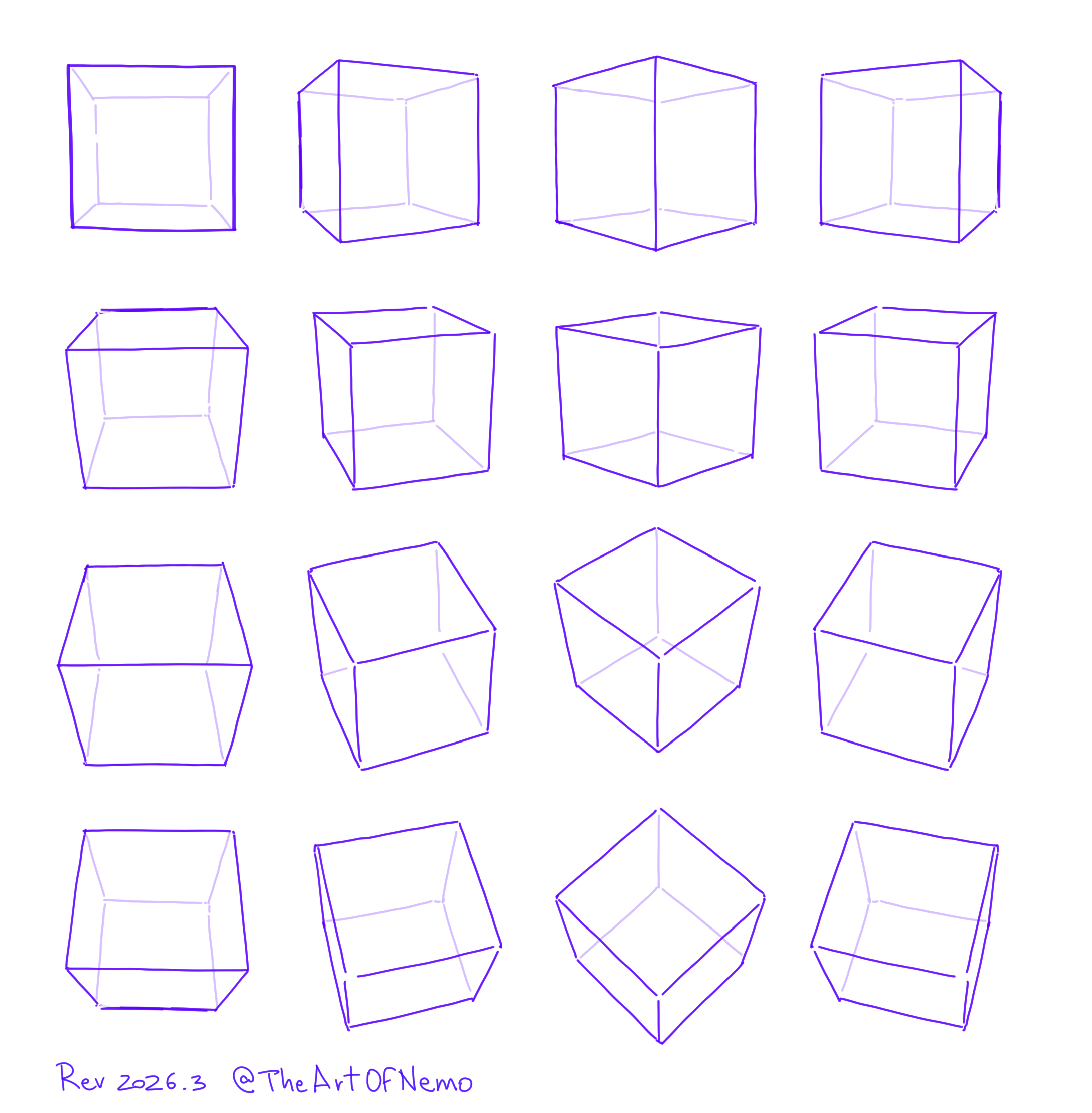
Here is the (corrected) box rotation matrix from the video!
Do notice that the 45 degree rotation, both horizontal and vertical, FEEL kind of narrow. That is because I overlaid an actual cube and retraced it. I would say, from a drawing standpoint, it FEELS like it they should be wider on the sides, so feel free to adapt them a bit. We are going for what feels right rather than what is 100% correct here.
If you want that kind of personalized feedback on your specific drawings, the mentorship program is built exactly for that.
Frequently Asked Questions
How long should I practice box rotation every day?
There is no set time, but you should not take more than 10 minutes for the whole Matrix at the beginning. If you do, it's too much. After practicing for a while, ideally you can reproduce it in just a couple minutes
Do I need to use a perspective grid?
NO. You can try the helpers from the video but in the end you should really learn them from observation.
Should I trace or use reference boxes when practicing?
Once again, hard no. Ideally observe each box, then try to reproduce it from memory. Then take the reference one and compare, fixing your mistakes, then trying again.
How do I know when I've gotten good enough at box rotation to move on?
When you can rotate a box to any angle of the matrix, and rotating the page around all of them still look like boxes.
Is box rotation only useful for hard-surface drawing?
Not at all. Boxes are the underlying structure of almost everything: figure drawing, heads, vehicles, environments. Mastering box rotation means you understand 3D space itself, which applies everywhere. And, with the 1:1:1 cube, you'll have an awesome tool to measure in perspective
Want this explained for YOUR drawings?
Theory only gets you so far. In a 1-on-1 mentorship, I look at what YOU specifically are doing wrong and fix it.